
Is a Golf Club Fitting Worth It? An Honest Answer From Our Fitters
Aug 24th 2026
A study of nearly 6,000 golfers by the Sports and Leisure Research Group found that 90% of American golfers may be playing clubs that don't fit them. Our fitters would tell you that number matches what they see walk through the door every day.
The question we hear most often isn't about shafts or lofts. It's simpler than that. Is a fitting actually worth it, or is that just something for good players?
We put that question to 4 of our guys: Eric Howard, store manager in Florence, Jake Wright and Jeff Goff in Lexington, and Rob Jones at Eastgate. Between them they have close to 80 years in the golf business. Here's the honest answer.
What a club fitting actually is
Strip away the launch monitors and the wall of shafts and a fitting is a simple idea.
"A club fitting is taking whoever you are as a player, your metrics, your stature, and getting you into the right equipment to make this game a little easier," Rob says. "Nobody is one size fits all. Neither are golf clubs."
Jake puts it another way. "It's allowing an artist to have the right brush to make the right strokes."
That's it. A fitting matches the club to the swing you actually have, not the swing a stock club assumes you have.
"But isn't it the golfer, not the clubs?"
This is the most common pushback, and it deserves a real answer instead of a sales pitch.
Yes, the golfer matters more than the club. Lessons and practice will always move your scores more than any driver. Nobody in our stores will tell you otherwise.
But here's what 25 years of watching swings taught Jeff. "Most people's impact position is pretty consistent, no matter how they get there. The swing may be inconsistent, but through the impact zone, the club comes back to a similar spot." That means your equipment can be matched to what you repeatedly do, even if your swing isn't pretty.
Eric takes it one step further. "Lessons definitely help and are a great part of the game. But lessons typically aren't valuable if the clubs are working against you from the beginning."
So it's not the golfer or the club. It's both. The fitting just makes sure the equipment isn't the thing holding you back.
Why average golfers benefit more than good ones
Here's the part that surprises people. Fitting helps the 18 handicap more than the scratch player.
"We hear all the time, I'm not good enough to get fit," Eric says. "Truly, I think amateurs benefit more than your scratch players. We need that consistency more than they do. For those of us that don't hit the center of the face, it has a huge impact on making your mishits better."
The logic is simple. Good players hit the middle of the face most of the time. You and I don't. A fitted club is built around your misses, so the bad ones cost you less.
"It keeps you from fighting an uphill battle," Rob says. "Grab something off the wall that's not to your specs and you're already making this game harder. Get something that's fit to you, and when you put a good swing on it, you get good results. Put a bad swing on it, and the results are still better than they would have been."
Eric adds one more point that hits home for anyone with a job and a family. "As amateurs, we don't grind on the range for hours a day. Our muscle memory is going to be what it is. Unless you do a complete swing overhaul with tons of lessons and range time, your misses are likely always going to be your misses. We're accounting for those misses."
What the numbers say
You don't have to take our word for it.
Golf Digest ran a season long case study, following 9 everyday golfers through full fittings. Eight of the 9 got better, dropping an average of 1.7 strokes over about half a season. They picked up an average of 21 yards off the tee and 13 with their irons. That's roughly one full club.
Jake sees the driver number play out in our bays all the time. "If somebody comes in with the wrong driver specs, they can pick up 10, 15, I've even seen 20 yards. Getting a scoring club in your hand lets you play more aggressive."
And the industry has caught on. Golf Datatech reports that nearly 8 in 10 serious golfers have now been fit for clubs. The people who play the most golf have already decided this is worth it. The average weekend player is the one still leaving strokes on the table.
What happens in a Golf Exchange fitting
If you've never been fit, here's what to expect. No test to pass, no judgment on your swing.
First, a conversation. Your fitter wants to know your game before you hit a ball. Eric asks every player the same thing. "What's the scary shot to you? If you're on a par 3 with water left, right, short, or long, which one scares you most?" He also wants one clear goal. Ten more yards, tighter dispersion, lower scores. Pick one.
Second, a warmup with your current clubs so we can see your real swing. Jeff's advice here is the best prep tip there is. "Swing like you would if you were out playing a round. People try to do something they think they should be doing instead of making their own swing."
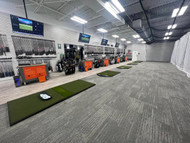
Third, we narrow down clubheads on a launch monitor. Our bays run Trackman and Foresight GC Quad, which track around 30 different data points on every swing. You don't need to know what any of them mean. That's our job.
Fourth, we build the club from the head down. Shaft, length, loft, lie. Jeff calls the shaft the most overlooked piece. "A lot of people overestimate or underestimate their swing, and buy a shaft that isn't properly fit for their speed." Jake says the same about length. "I hear a lot of people come in and say the length feels a little too long. They're hitting behind it or thinning it." His fix is often a half inch, sometimes just a quarter.
Fifth, we dial in the grip and grip size. "Everybody sleeps on the grips," Rob says. It's the only part of the club you actually touch.
Then you get the specs, and as Eric puts it, "you'll probably never think about it again." That's the point.
What it costs, and the cheaper ways in
Two things most golfers don't know.
First, custom builds at Golf Exchange come at no upcharge. The fitted club costs the same as the one on the rack. You're not paying a premium to get the right specs.
Second, a fitting doesn't have to mean new clubs. Eric explains what we call a retro fitting. "A $1,200 iron set isn't in everybody's budget. If your budget is $600, we can find a used set, bend the lie angles, get the grips right for you, and fit it to you, too. It doesn't have to be something generic off the wall."
Every used club we sell also carries a 30 day playability guarantee. "You get to play it outside and see how it works in real time," Rob says. "Indoors versus outside is different. This way you make sure it's right for you."
That's the honest math. Fitting isn't a luxury add on. It's how you make sure whatever you spend, $600 or $1,200, actually works for your swing.
When you should wait on a full fitting
We'll be straight with you here too. If you've never swung a club and you're not sure golf is going to stick, don't book a full bag fitting yet. Start with a package set, take a few lessons, and get on the course. Jake recommends exactly that for brand new players. "It's a great starting point to get them out on a course and swinging. From there we can slowly piece things together."
Even then, come see us for 5 minutes and let us check your length. We recently fit a 6 foot 9 college athlete who had just started playing. He didn't need a full fitting on day one. He absolutely needed clubs the right length. Playing the wrong length teaches you bad habits from your very first swing.
Once you can make repeatable contact, that's when a full fitting pays off the most.
Common questions about club fitting
Is a fitting worth it for a high handicapper?
Yes, and usually more than for a low handicapper. Fitted clubs are built around your misses, and high handicappers miss more. A 20 handicap who improves 10% saves 2 full strokes a round. A scratch player saves a fraction of one.
How much does a club fitting cost?
Our fittings start at $50, and custom builds come at no upcharge over rack price. Ask in store about applying your fitting fee to a purchase.
Do I have to buy new clubs after a fitting?
No. We can fit you into used clubs, adjust the set you already own, or simply hand you your specs. As Rob puts it, "We want to make you a better player overall, not just sell you new equipment."
Can you fit used clubs?
Yes. We bend lie angles, adjust lofts, and set up grips on used sets all the time, and every used club carries our 30 day playability guarantee.
How should I prepare for a fitting?
Bring your current clubs, wear what you'd wear to play, and show up with one clear goal. Know your scary shot. Then swing the way you swing on the course, not the way you think a fitting wants you to.
Come see why Golf Digest ranks us
All 6 Golf Exchange locations have been named an America's Top 100 Clubfitter by Golf Digest, and our Florence and Lexington stores are the only Top 100 Clubfitters in the state of Kentucky. Across our stores, 28 fitters carry 421 combined years of fitting experience.
Book a fitting at any of our 6 locations. Or stop in, hit a few balls, and ask us the scary shot question yourself.